
Greenburgh City Directory Collections
No verified, continuous standalone Greenburgh city directory series was located in the official-source research. The useful shelf is regional. It follows the Harlem Railroad and nearby commercial centers, so a Greenburgh family can appear under a nearby locality instead of one town heading. The table separates verified runs from the local-history collections that help place their evidence. Catalog access does not guarantee that every image is open online, and an entry should always be cited with its volume, year, locality heading, and page.
| Collection | Years | Where Held | Access |
|---|---|---|---|
| West Chester County directory | 1860-61 | Allen County Public Library city-directory collection | Collection reference; inspect Westchester locality entries. |
| Curtin's Westchester County Directory | 1871-72, 1873-74 | Ancestry U.S. City Directories collection | Access depends on a library or account. |
| Turner and Richmond corridor directories | 1891-92, 1903-17 | FamilySearch catalog and microfilm | Some images can require an account or a FamilySearch center. |
| NARA White Plains city-directory volumes | 1928-32 | National Archives circa-1930 guide | White Plains volumes include Elmsford, Hartsdale, and Scarsdale. |
| Westchester business directories | 1922-27 | Allen County Public Library reference | Business and person context, not a complete household roll. |
For a house in a Greenburgh village or unincorporated neighborhood, begin with the title's place names as well as the town name. A missing result can mean the wrong locality heading was searched, not that the household was absent. The Greenburgh Public Library and Westchester County Archives are the practical next stops when a catalog reveals a relevant run but the page image or a shelf list is unavailable.
Greenburgh's Corridor Directory Pattern
Rail and postal geography shape the historical record. Turner and Richmond titles name White Plains, Hartsdale, Scarsdale, Valhalla, Hawthorne, Sherman Park, and other communities along the Harlem Railroad. Greenburgh itself contains six incorporated villages and several unincorporated areas, while a record may also use a White Plains, Scarsdale, Elmsford, or Tarrytown mailing label. Those labels are clues to search, not interchangeable municipal boundaries.
Search the exact street or surname under Hartsdale, Greenville or Edgemont, Elmsford, East Irvington, Fairview, North Elmsford, South Ardsley, and the river villages when the date and address point there. Preserve the spelling and locality printed in the volume. That practice prevents a modern place name from erasing the older vocabulary that made the directory findable.
Note: A directory locality identifies the publisher's organizing geography and does not, by itself, establish present-day town or village jurisdiction.
Turner, Richmond, and Greenburgh Directories
The earliest located Greenburgh-relevant run is E. F. Turner & Co.'s 1891-92 directory for the Hartsdale and Town of Greenburgh area. Later W. L. Richmond volumes cover the same broad corridor in 1903-04, 1904-05, 1905, 1906-07, 1907, 1908-09, 1913, 1914-15, 1915, and 1916-17. The titles vary, so cite the publisher and year rather than calling all of them one uniform town series.
FamilySearch's directory catalog is the finding aid for several of these corridor volumes and microfilm items.
The catalog helps identify a title, reel, item, and locality before a researcher requests access. It does not prove that a standalone Greenburgh run exists, and it does not replace reading the actual entry.
The NARA guide supplies a second cluster: White Plains volumes for 1928-29 and 1930-32 that include Elmsford, Hartsdale, and Scarsdale. For a Greenburgh address, these runs are a bridge between early corridor books and later local sources. They are not evidence that every household in the town received a listing.
Greenburgh Library's Directory Context
Greenburgh Public Library's Local History Room is a strong place to turn a directory name into a usable historical question. The collection includes digitized newspapers, rare books, maps, and other local material, and the library asks researchers to schedule with the Local History Librarian. Its grant inventory describes manuscripts, books, maps, a 1915 Town of Greenburgh atlas, newspapers, veteran interviews, diaries, photographs, negatives, and slides.
Greenburgh Public Library provides the local-history contact route for collection names, appointments, and finding aids.
The library image is a reminder to ask about the relevant locality and format, not simply for a generic resident list. Current public pages do not publish a definitive Polk run, reverse-directory shelf list, or obituary-index date span, so those details should be confirmed with the librarian.
Reading a Greenburgh City Directory
A city directory is a dated publisher compilation, not a title record or a current resident roll. Transcribe each line as printed before trying to modernize it. The sources support a field inventory, but no page-level Greenburgh abbreviation key was verified. A mark that looks familiar in another directory should therefore be recorded exactly and checked against the front matter of that volume.
| Name as printed | Capture surname, given name or initials, alternate spelling, and any household members shown. |
|---|---|
| Family clue | Record a spouse name in parentheses or a widow notation when the entry supplies one. |
| Occupation or business | Keep the wording and any named establishment as a period clue. |
| Address and locality | Copy street suffix, number, locality heading, and whether the entry is alphabetical, classified, or address ordered. |
| Residence notation | Preserve any home, room, owner, or occupant mark without assigning an unverified meaning. |
| Page citation | Note directory year, page, cross-reference, and every abbreviation or uncertainty. |
- Criss-cross directory
- An address-ordered section that can group entries by street when the volume includes one.
- Householder index
- An alphabetical list organized around a household name rather than a complete census of everyone at an address.
- Abbreviation key
- The volume's own explanation of short forms, usually in its preliminary pages. The local key must be checked, not guessed.
Greenburgh Atlas for Directory Addresses
The 1915 Town of Greenburgh atlas is a practical cross-era bridge. An old directory may use an estate, road, station, or neighborhood name that does not look like a current address. Start with the historic wording, identify a present-day road or nearby landmark, then compare the result with a current parcel card, tax map, survey, or legal description. Reverse the direction for a deed that names a farm or adjacent owner.
METRO's Greenburgh Local History Collection description identifies the atlas alongside newspapers, diaries, interviews, and photographs that are being digitized.
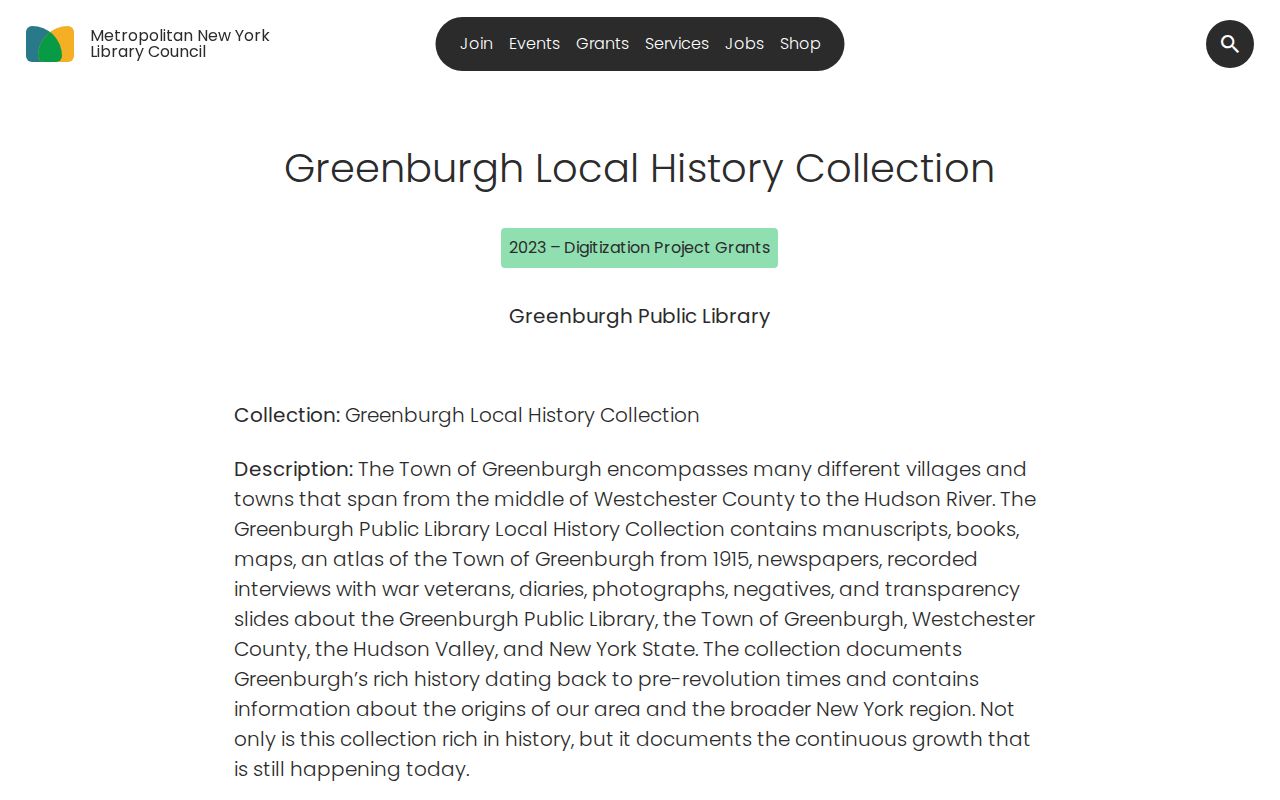
Those companion materials can explain a street, club, estate, or neighborhood reference beside a directory entry. A newspaper mention or photograph is supporting context and should be paired with a dated primary record when a conclusion matters.
Greenburgh Archives Beside Directories
Westchester County Archives in Elmsford can test a directory clue against county evidence. Its Reading Room holds county government records such as wills, deeds, naturalizations, maps, and photographs, alongside the Westchester County Historical Society library's local books, genealogical files, manuscripts, and maps. The room is open to the public on Tuesdays and Wednesdays from 9 a.m. to 4 p.m.; photo ID and researcher registration are required.
Use the guide to collections, online indexes, container lists, and the Historical Society card catalog to identify a record group before requesting material. Staff deliver archival items, which do not circulate, and researchers use call slips for up to three items at a time. For a distant researcher, the Archives offers research by mail, including a specific record and custom research option. This is a sound fallback when a directory name needs a deed, estate, map, or naturalization record beside it.
Tracing Greenburgh City Directories
Directory years can frame a household trail between broader census intervals. Begin by fixing the parcel and the historic locality name. A result under White Plains or Hartsdale may be the correct Greenburgh lead if the road, household, or nearby place fits. The historical volumes are useful starting evidence; a change in the printed line calls for a second record before it becomes a conclusion.
- Record the address, current parcel details, former street wording, and the closest historic locality before opening a directory.
- Search a surname and street in the 1903-17 Turner and Richmond runs, then test White Plains, Hartsdale, Scarsdale, Elmsford, and other relevant headings.
- Compare consecutive entries for address, spouse or widow notation, occupation, business clue, and street order.
- Pair the best directory years with the 1900, 1910, 1920, 1930, and 1940 federal censuses, the 1915 New York State Census where available, and the 1950 federal census when the dates fit.
- Check a deed, assessment, permit, obituary, cemetery record, or probate file to explain a move, surname change, or disappearance.
Federal individual census schedules through 1950 are available under the 72-year release rule, while the 1890 federal schedule is largely lost. Census locality and enumeration-district labels can differ from a directory heading. Match the house number, neighboring sequence, and date instead of assuming that a shared place name proves the same parcel.
Dating Greenburgh Directory Clues
A directory's publication year, compilation date, and a family's actual move date are separate facts. Women, boarders, rural households, and people who did not provide information may be absent. A street line may also point to a business rather than a home. Treat absence as a search result that suggests a different heading, spelling, or source, not as proof that the person was not in Greenburgh.
The historical record has no verified story of a courthouse fire or complete Greenburgh record loss. When a directory trail breaks, ask the Archives about maps, surrogate files, deed books, newspapers, or a neighboring jurisdiction. Keeping the source URL, title, year, page, and limitation beside every note makes later checking much easier.
Note: A cited directory entry is strongest when its locality, date, address, and a separate corroborating record all point to the same household.